
 |
|
My Health Log: Page Four Previous Pages: PAGE #1 Aug -Oct 2003 (newcomers, read this FIRST!) April 1st, 2004. I've been working my way toward vegetarianism for a few months now. I've been off red meat for a while, and I dropped chicken a couple of weeks back. It's been just fish for the last three weeks or so. Many of my carnivorous friends tell me that vegetarianism "isn't natural," but, for that matter, neither is wearing clothes or driving around in cars, so I'll make a deal: If they start running around naked and walking everywhere instead of driving, I'll eat at Krystal's now and again. I'm not heading toward becoming one of these Vegan folks any time soon --though I admire them -- who won't eat ANY animal product. The point of a Buddhist avoiding meat is that you have compassion for all living things, and eating something isn't a compassionate act. As far as I'm concerned (and I've had relatives who farmed) milking a cow doesn't hurt it, nor does it hurt a chicken to lay an egg, so for now cheese and some egg now and again is still in John-boy's diet. One of the strategies for weight reduction when you eat out is to realize that if you eat what's set before you, you'll probably eat too much -- and you'll definitely get a lot of fat and hidden calories. For example, I picked all the cheese, nuts, eggs, and croutons off of a "garden salad" from a local restaurant and piled them on a plate: three hundred calories, easily! So you have to learn to ask your server to prepare your food the way you want it. To grill it, not dip it in batter and crispy-fry it to a Golden Brown. And when they grill it, to go easy on the oil and not grill it in creamery-rich butter. You have to ASK these things, because a restaurant will do anything it can to make its food taste good, and this often means using calorie-rich butter and creams. IHOP, as you may know, is a favorite place for truckers to eat, and the food there is GREAT; just not the most health-conscious place on the planet. So when I asked for an all-vegetable salad, the waitress looks at me and says, "Huh? Is that on the menu?" Of course it wasn't, most of their salads come in a fried shell with a half-pound of guacamole and sour cream, or with a half-pound of luncheon meat and cheese mixed in. I told her that is wasn't, so she asked me to order one of the salads on the menu and she'd tell them to leave off what I wanted them to leave off. So I ordered the Chicken Fingers Salad, and said, "Leave off the cheese, eggs, dressing, croutons and chicken." She looked at me -- bless her heart -- like a deer in headlights, and asked "Leave off the chicken?" "Yes please." "No chicken?" "No Chicken. And could I have some vinegar on the side?" "Uh ... okaaaay ...." After consulting with the chef, she came back and asked, "Is malt vinegar okay?" "Yes, I love it," I assured her. So basically I got a big bowl of lettuce, over which I squeezed a lemon wedge, dribbled some vinegar, and sparingly used the Lite Italian dressing. I crumbled some crackers on it for the carbs. A perfect meal, except there were no tomatoes, or anything other veggies on the salad (they're purists at IHOP). Fortunately, my son, who was with me, ordered a Triple Bacon Double Cheeseburger and gave me his tomatoes and onions. He's a purist too. He won't allow any veggies to corrupt his system. But, they still tried to kill me. My Big Bowl of Lettuce came with a HUGE piece of buttered French toast. April 4th, 2004. Buddha was not a fat guy. That big tubby chap you see sitting next to the register at Chinese restaurants is the Laughing Buddha, based on a 10th century Chinese wandering Buddhist monk named Pu-tai, who believed that worldly pleasure and material success was GOOD. All sources describe him as obese, with wrinkled forehead, and a white protruding belly which he left uncovered. That sounds like me, except I try to keep my shirt buttoned at all times.
I say this because at one point, when I was much heavier, word got out that I was seriously studying Buddhism. Some people, thinking they were being funny, told me, "Well, you got the Buddha part down," no doubt referring to my resemblance to old Pu-tai. I guess being compared to Chinese Laughing Buddha is better than being called a Fat-Assed SOB. I guess. I spoke once about being mindful about eating and appetite. Sometimes it's hard for compulsive eaters to separate real hunger from emotional hunger. One technique I've found useful is to assign a rating system to your appetite. When you feel the urge to eat, don't act on it immediately. Examine it; go into it. Is it physical or emotional hunger? If it's physical hunger, assign a scale of 1-10 to it. I don't eat unless my appetite crosses the "5" or higher mark. I try to keep it around the mid-point, because I know if I let it roam too high I'm likely to overcompensate by overeating. You should never be too hungry or too full. Perhaps the Zen masters put it best. When asked how Zen is practiced, a practitioner answered, "When I'm hungry, I eat. When I'm tired, I rest." So the student asked, "Isn't this like everyday life?" The Master answered, "No, it's not like everyday life. When a normal person eats, his mind solves a hundred problems. When he rests, his mind wanders to a hundred places. When a Zen practitioner eats, he just eats. He is fully in his eating. When he rests, he just rests. He is fully in his resting." Here's an essay on "Mindful eating" by Thich Nhat Hanh Tangerine Meditation-- Thich Nhat Hanh (From Peace is every step)One day, I offered a number of children a basket filled with tangerines. The basket was passed around, and each child took one tangerine and put it in his or her palm. We each looked at our tangerine, and the children were invited to meditate on its origins. They saw not only the tangerine, but also its mother, the tangerine tree. With some guidance, they began to visualize the blossoms in the sunshine and in the rain. Then they saw petals falling down and tiny green fruit appear. The sunshine and the rain continued, and the tiny tangerine grew. Now someone has picked it, and the tangerine is here. After seeing this, each child was invited to peel the tangerine slowly, noticing the mist and the fragrance of the tangerine, and then bring it up to his or her mouth and have a mindful bite, in full awareness of the texture and taste of the fruit and the juice coming out. We ate slowly like that. Each time you look at a tangerine, you can see deeply into it. You can see everything in the universe in one tangerine. When you peel it and smell it, its wonderful. You can take your time eating a tangerine and be very happy. April 10th, 2004. Here's a poem:
Now examine that sensation. Other than the pain -- which is intense, numbing, shocking -- you'll feel almost paralyzed by the rush of emotions, so many of them that you can't even sort them out for several moments. Go into them; examine them. Shock, anger, killing rage, perhaps? Your eyes tear up, you want to cry, and that shames you too. Now, when you get past the urge to kill your friend -- who, after all, was just doing you a favor -- repeat the experiment, but this time, place a large firm pillow between you and the blow. You still feel it, but it isn't anywhere near as bad. And I'll bet you didn't feel ANY of the emotional reactions at all. I'm sure you get the point. I won't insult your intelligence by explaining the analogy between this sadomasochistic experiment and weight gain, except to point out that not all slaps to the face are physical ones. April 16th, 2004. I find myself eager to get on with the next phase of weight reduction -- which of course means tackling another bout of emotional issues. Fortunately, springtime is a relatively pleasant time of year to do so. I can find serene riverside banks alongside which to introspect, and walk along the bike trails of my youth, etc. My vegetarianism is progressing nicely; I find it isn't all that hard to do. Morningstar Farms has some great meat substitutes that I've used a lot anyway. What I find funny is how strenuously some of my friends and associates fight this notion. Some even get defensive. It reminds me of when I quit drinking alcohol about twenty years ago ... all my drinking friends got mad at me, like it was a personal affront. The "against nature" argument comes up a lot. Sure, it's in a cat's nature to eat a rat, but I'm not a cat or a rat. I'm a man, and I have a choice. And my choice -- at least for today -- is that I don't want something else to die just so that I can have a meal. Meat doesn't appear by magic; there's a violent process that produces it that we have to accept if we're going to consume flesh. For example, if you like pork products and want to see how that piece of bacon gets to your table (and if you have a particularly strong stomach) here's a link for you. But don't say I didn't warn you. Being a carnivore is not for the faint of heart. Will vegetarianism help weight reduction? I dunno ... movie popcorn is meat-free but full of calories, and I could live on the stuff. I told you about my experience at IHOP. Ha ha -- it happened to me again ... I was at Appleby's looking for some vegetable fare, when I noticed that the Mandarin Chicken Salad had a Lo-Fat symbol next to it but the Steamed Vegetables and Salad Combo did not. Strange, I thought to myself. So I asked the waitress why this was so. She looked blank, then said, "Because you need some fat in your diet?" I said, "Well, I don't understand why steamed vegetables and a salad would be higher in fat than a Mandarin chicken salad ... aha -- does it have cheese?" "Yes," she said. "And bacon, eggs, croutons..." "Okay, I see now. I'll have the Steamed Vegetables and Salad Combo, but no meat --" "No bacon?" "ABSOLUTELY no bacon. No cheese either." I had a few of the croutons, but picked most of them off. I think they dip the little toasted bits of bread in a bucket of melted butter. Also, the salad comes with a piece of "garlic bread," aka a six-ounce crouton (also dipped in that same vat of melted butter). But I made out all right. It's tough making the segue from carnivore to vegetarian, but I can feel my karma improving already. April 18th, 2004. Well, my weight has begun to budge again, thanks in part to increased energy and my vegan diet. "Vegan?" you ask, with a puzzled frown. "I thought you weren't going that far?" Well, I changed my mind. I decided fish were off limits for me too. It's veggies all the way. Coincidentally (or is it Fate?) I found the following passage in Buddhist scriptures:
There's some debate amongst scholars as to whether or not this is a genuine passage or a later addition to the Sutras. I don't really know, but it echoes m sentiments and my interpretation of the First Precept to attempt to do no harm to any sentient being. I'm not on a soapbox, nor am I trying to change anyone's lifestyle. But the purpose of this blog is to document what's going on with my food, weight and emotional issues, and I would say that an ethical decision involving meat falls into all three categories. So what am I listening to when I crave unhealthy food? Hmm ... I'll list no answer for this, as I think it differs for each of us. My answers are personal to me. Yours are to you. It behooves us to listen to our heart and ask it what it wants. I was reading a psychology textbook and saw a list of the top ten most stressful events in a human's life. I discovered that I've experienced four of the ten during the past six months! And I haven't gained any weight, and even managed to drop quite a bit. My plan works better than Atkins.
The problem is that when we try to avoid pain, we intensify it. It's paradoxical but true. Eventually, the pain avoided today will come back to haunt us, with interest. This applies to both physical and psychological pain. I would like to suggest an approach to try the next time you really hurt. Or perhaps you hurt now, and can take a moment to try this technique. It's a meditation technique, so you have to find a quiet spot where nobody will bother you for a while. First of all, assuming that this is a physical pain -- like a backache -- you have to realize that your body isn't you. Understand that thoroughly before you begin. You are not your body, nor is it you. The body is a vessel or vehicle in which you reside for this lifetime. Now, focus your attention on the ache or pain; don't try to run from it. Go into it, examine it. You'll notice after a short while that it isn't a constant sensation, that it rises and falls in waves. You'll also notice that the more you examine it, your curiosity about the sensation increases and the pain has less control over you. Now, since this isn't your body (and by extension, this isn't your pain, though you are aware of it) can't you find it in your heart to feel compassion toward that aching back (or knee, or head)? Send it love, kindness, compassion. Don't feel sorry for yourself -- because this isn't about YOU -- feel compassion toward the painful body part. This may sound silly to you, but for many people, it WORKS. We resist pain, which makes it hurt more. With this technique, resistance ends, we tend to relax to the sensation, and the body's natural painkillers kick in. With some thought, it also works on psychological and emotional pain as well, but sometimes it's a lot more difficult to separate US from our feelings and thoughts. It can be done, though. Here's how: Perhaps the emotional pain involves an incident that happened when you were a child. Can you step back and feel compassion for that child? Not for YOU, because you are not that child; you're an adult. But can you see the child and feel for that child? Can you mourn, grieve, sympathize for the child -- then feel pride for the way he or she moved past the incident to become a successful and functional adult? Try this for any hurt, up to the recent past. After all, you're not the same person you were yesterday. Consciousness is recreated constantly, rising and falling in waves too brief to measure. We die to ourselves each day -- and are subsequently reborn. All we have to connect ourselves to ourselves is our memories, and these are imperfect records of our experiences. In most cases, I suspect we're a lot harder on ourselves than we would be on others. So the trick is to learn to see ourselves through the eyes of someone else. Can we forgive the person we were in the past for being less than perfect? Can we feel compassion for the foolishness of our younger counterparts? Can we let go of the anger, distrust and grief that were the legacies of our past? Can we? But is it possible to have a relationship with another person without trust? Can we have a relationship with ourselves without trust? I've discovered, at almost 44 years of age, that I've never really had a relationship with another human being. I've been married to people, lived with them, slept with them, argued with them, maybe loved them -- I'm not sure I know what that means, but maybe -- but I'm pretty sure I've ever had that one-on-one, open, trusting relationship I've heard about. What's known as a partnership. I'd like to, but I just don't know how to do it. My mother and my father taught me to never trust another human being with my heart. They did this by breaking mine over and over until I learned that the only sanctuary for it was in keeping it to myself. I suppose their parents did the same to them, and their parents to them, ad infinitum. You know, the old-fashioned ways are best. But food, now, it's always there for you, always warm and delicious. Pizza is always gooey and rich, and ice cream is sweet and cold, chocolate gives you that loved feeling due to the hormone oxcytocin. There's no judgment or trust issues with food. It's easy to turn to this amenable, too-available source of comfort. But too much food, or even the wrong food, hurts us. It's not an act of love to overeat. The body is the raft that carries us through life to whatever healing awaits us and we have to take care of it. This requires discipline and compassion for our personal needs. And even though we may have no problem feeling compassion for others, we often stop short when it comes to feeling compassion for ourselves. There is a lot of suffering in the world, very true -- but this neither diminishes nor extinguishes our own, personal struggle. Often, the harshness we feel toward ourselves are echoes of what we've been told about ourselves by others. We're afraid -- we FEAR -- that what we've been told about ourselves is true. The sad truth is that we treat ourselves worse, and judge ourselves far more harshly than we would others. But the Buddha himself once said that we could search the whole world and not find anyone more in need of compassion than ourselves. What has this to do with trust and relationships? It seems to me that trust can't occur without the elimination of this personal fear. Perhaps the first step in learning to trust is feeling compassion for those who break us. Shouldn't this brave act free the heart of fear? And in that fertile field, it seems, trust will find a place to flower. When we learn to trust ourselves, trust for others will naturally follow. Or so I'm told. I'll have to take it on faith for now. Notice the perfect duplication of the branches and leaves of trees. The leaves and branches, by the way, matched that of the local foliage. Look at the detail. Even though a cruder replication would certainly do for Nature's purpose -- presumably protective camouflage -- this is the work of a master watercolorist. I was entranced by this miracle. I sat and looked at the moth, marveled at it, for over an hour. The moth let me. I found out later that he Luna moth only lives a week. An hour of its time was quite a span. I regretted taking up so much of its short life. By all accounts, I'm an educated man. I have a college degree; I understand evolution, natural selection, adaptive coloration, etc. But nevertheless ... I also recognize a miracle when I see one. I acknowledge Magick. Magick has been defined as controlled and properly directed will. By that definition, I think the moth is indeed Magickal. I refuse to believe that the miracle of the moth's wings just happened. On the subject of free will, the Buddha remarked, "So many factors go into a single event that it would be impossible to determine if our actions are predetermined or the result of free will." He went on to say, "Only an Omniscient Being could grasp the events leading up to a single shimmer in a single eye in a single feather in a Peacock's tail." Or perfectly rendered branch proudly displayed on a moth's back? My mind staggers in its attempt to imagine what must have gone into the masterwork of that moth's wings. I'm glad to live in a world that can present me with such marvels now and again. April 26th, 2004. This morning I stepped on my scales and my weight was 248! This is the first time I've been below 250 pounds in seven or eight years. A major breakthrough. It's going slowly, but I'm doing some major spiritual work right now. I'm about to begin some major PHYSICAL work too, which will definitely help. More later. May 9th, 2004. Happy Mother's Day to all you mother's out there. You are blessed. Sorry I've been remiss in posting. I've been really busy with shows, but here's a brief update: Still a vegetarian -- it's a very clean feeling; hard to describe but the body definitely feels cleaned out. Still deep into Buddhist studies. Not ready to take to the yellow robe yet, but it's had some very deep impact in my life. And -- more importantly to this project -- my weight is down to 246 pounds! May 15th, 2004. I've tried my best not to get involved in this war. I've tried my best. But ... The mistreatment of the prisoners. An American citizen beheaded. And teenagers in California SEEING it. Everyone SEEING it on the internet. Oh no. How can this be? The Words of the Buddha from Dhammapada. Please listen:
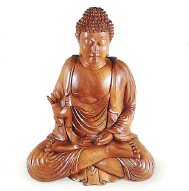
To the average person, this seems ridiculous upon first hearing. Of course we have a self. Don't we? I think I have a self; there's a voice in my head. Let's go into it. Here are the five aggregates: Form (body), volition (the part of us that "decides"), perception (recognition) feeling and consciousness (in Buddhism, the senses). Within these, we'll look for the location of "self." Well, I think we're all pretty well agreed that the Form isn't identifiable as this hypothetical self. If anything, it's the vessel. So far, so good. Volition is will, determination, decision -- basically, any motive impulse that causes us to DO. It's linked with karma, which is another story. I think we're safe in saying, though, that volition isn't the "self." Perception is the part of us that detects objects. For example, when we look at a glass, perception recognizes that we're looking at a glass, that it has a certain color, texture, weight, etc. Perception evaluates and assigns values to objects. Likewise with the other senses. Is this then, "self?" No, because there's no driver behind the wheel here. Perception simply identifies. We have to move on. Feeling? Nah. Feeling is very simple: pleasant, unpleasant or indifferent. Feeling is sensation, and we can all agree that while feeling definitely has its place in our makeup, it cannot be the "self." Consciousness in Buddhism is the six senses. Six? Yes, in this model the MIND is considered a sense organ, because just as the eye senses visual objects, the mind senses thought-objects. This is an important concept later on as a person gets deeper into Buddhist studies; you can't gloss over this point. Here's where we're most likely to find that elusive SELF. I believe that when most people think of "I" or "Me," we think of that voice in our head. We'll bypass the ordinary five sense-consciousnesses of eye, ear, taste, touch and smell and get right to mind-consciousness. Remember that what we're looking for is a "self" that exists in and of itself, apart from any other component. By definition, that's what it has to be to qualify as a "self." When we strip everything else away, what remains must be "self." We can do this with every other aggregate. If we try to make the mind the "self," let's see why we can or can not. The "voice in our head" is thought. So who is the thinker? The rather startling answer, which you can determine for yourself simply by sitting in a quiet room and examining your own inner workings for a while, is that there is no difference between the thinker and the thought. Each is a reflection of the other. To an outside observer, a man standing in front of a mirror appears to be two men. However, remove the man and the reflection disappears. This is exactly the relationship between thinker and thought: If you remove one, the other disappears. You want proof? Try a severe head injury. Modern cognitive theory tells us that thought consciousness operates via the electrical firings between neuronic synapses. Where, in all this electrical activity, is the "I?" Thought changes moment by moment, rising and dying with each passing micro-second. Plus, as I rather gruesomely pointed out, thought can be damaged and impaired by a good blow to the head. A "self" by definition should be permanent and unchangeable. There's nothing in us that meets this definition. So, "self" isn't thought either, because if you strip away thought, the thinker vanishes too. We've stripped away everything, just as the Buddha did, and haven't found the "self." Oh well. So why do we have this illusion of a continual self? Well, the five aggregates work together to create the "self" as a temporary, functional formation in order to operate as a cohesive entity. Without it, we would be like five horses trying to pull a stagecoach in five different directions. It's when we pull the aggregates apart that the illusion of "selfhood" vanishes. "But wait," I hear someone asking, "What about the soul?" Oh man, let's not go there.
And it's time for another sermon. The First Noble Truth boils down to "Existence is marked by Suffering," or as some translators abruptly put it: "Life is Suffering." When most people hear this, there's a knee-jerk objection that usually comes out as, "Oh but life is more than just suffering -- there's happiness too!" Well, yes there is, but human HAPPINESS isn't a problem. We don't sit around and bemoan the state of human happiness. We don't spend all of our time trying to solve the problem of too much HAPPINESS in our lives, or in the world. Actually, there's a problem with happiness, too: it isn't lasting. Actually, states of happiness never last very long at all. They're subject to decay and are by nature impermanent. So even happiness eventually leads to disappointment. This is part of the First Noble Truth too. Most -- and I mean most -- of human endeavor is spent on the alleviation of human suffering. The disciplines of medicine, science, psychology, law, technology, religion and philosophy -- you name it, all concerned with the problem of human suffering and how to alleviate it. This is exactly the problem Buddha set out to solve. The Second Noble Truth: Suffering Has a Cause. And that cause is threefold: Clinging, Aversion and Delusion. Of these three, the Buddha placed particular emphasis on clinging. Clinging refers to selfish desires, greed, attachment to the pleasant, separation from the pleasant. An unsatisfied desire is suffering. A satisfied desire increases desire like drinking salt water increases thirst, because -- as noticed earlier -- no state of pleasure lasts forever. We crave more and more, like an addict craves his or her drug. At the heart of this Noble Truth is this realization: The more we chase happiness -- the more we desire it -- the further away it seems. You know this is true. Look into your own heart, at your own life, and tell me that it isn't. This leads us naturally into the Third Noble Truth: By Ending Desire, Suffering Ends. Does this take the passion out of life? Does this mean we no longer love our friends and significant others? No. All it means is that we quit clinging to (or depending on) anything for happiness outside of ourselves. We accept that everything in the world is subject to the laws of impermanence and change. We still enjoy life. We still take great pleasure in things. In fact, we take more pleasure in experiences because we realize that everything passes away. The Fourth Noble Truth tells us that by following the Eightfold Path we can realize a state of existence called Nirvana. When you realize that the word Nirvana comes from two Pali words Nib (end) and bana (desire), it gives you a clue about the nature of this state. Nirvana is a state of existence that can't be described. it isn't a heaven state, nor is it non-existence as some of the early translators thought. Many thousands of words have been written telling us what Nirvana isn't, but what it is exactly nobody who isn't Enlightened knows. It is the Indescribable.
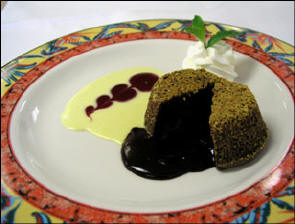
Now, let me tell you this: the other day, I had this terrific craving for something involving chocolate and caramel. So I went to a really good restaurant and ordered a dessert with coffee and enjoyed every bite, with total concentration (see my discussions on Mindful Eating). Man was it good. Did I kick myself? Did I think, "Oh No! I broke my winning streak! Now I'll gain all that weight back!" Did I think any of these thoughts? Hell nah. How silly. My relationship with food has totally changed. If you've followed the course of this rambling blog, you've seen my process for reprogramming my emotional relationship with food over the past year. I don't do that all-or-nothing, panic thinking, guilt stricken type of behavior. It was a piece of amazingly delicious sweet food. And I enjoyed it. It satisfied a craving. And I let it go. My next meal was a vegetable stir-fry with tofu, which I enjoyed just as much. The one after that was a veggie delight sandwich from Subway. And so on ... I think the point here is that if you make something too difficult on yourself you won't stick with it. Someone, an outside observer, might say that I was "cheating" on my diet. There would be several inaccuracies with this statement: (1) I'm not on a diet; my approach to weight reduction is strictly focused on dealing with the emotional underpinnings and letting the food issues take care of themselves as the body seeks its own "healthy zone" (2) "cheating?" Cheating who, and according to what rules? There's no emotional issues tied in with my eating. When you consider all the factors that contribute to your physical, emotional and mental well-being -- environmental, genetic, psychological, the whole spectrum of human life -- the single factor over which you have the most control is what you eat. Wow. Food is very serious business. May 30th, 2004. Weight reduction alert: down another coupla pounds, this morning I was 244. Well, sometimes I find it difficult to practice Right Speech when dealing with stupid people. Especially stupid people who read a few new-age books and try to sound like Enlightened gurus. I won't go into details but I made many sarcastic remarks this weekend that probably set my karmic cleansing back several lifetimes of unfortunate rebirths. I attempted to trace back my family tree, but in East Tennessee sometimes you just DON'T WANT TO KNOW. You know how usually the chart start with you, then branches off into two, then four, and expand outward? Well, mine went in angles, doubled back on itself, traveled back through time, and from what I could gather, I'm my own cousin. The resulting diagram was so confusing that I took it to a geometry professor to try to figure it out. He got back with me and said, "Well, there's good news and bad news. The bad news is that, genetically speaking, you're probably not legally a human being. But the good news is that you've been nominated for the Nobel Prize for coming up with a new twist on Chaos Theory." |
 Okay,
so I'm with some friends at IHOP and I ask the waitress for
a salad with no cheese, meat or croutons ...
Okay,
so I'm with some friends at IHOP and I ask the waitress for
a salad with no cheese, meat or croutons ...

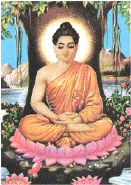 In
reality, the historic Buddha lived in what is now Nepal and
was a lean, wiry man of medium proportions, practicing
healthy dietary habits. Like all mendicants of his
times, he ate one meal a day, in the morning, and possibly
some olives at night for medicinal purposes. The
picture to the left shows how he is usually pictured in his
homeland.
In
reality, the historic Buddha lived in what is now Nepal and
was a lean, wiry man of medium proportions, practicing
healthy dietary habits. Like all mendicants of his
times, he ate one meal a day, in the morning, and possibly
some olives at night for medicinal purposes. The
picture to the left shows how he is usually pictured in his
homeland. April
11th, 2004.
If
you'd like an insight into why some people put on large
amounts of weight, try this experiment: Get a friend,
hopefully someone with a good amount of strength, to give
you a good, hard, open-hand slap right across the face.
I mean a vicious one, delivered with lots of power, like a
piston. Hell, get them to call you an insulting name
while he or she is at it.
April
11th, 2004.
If
you'd like an insight into why some people put on large
amounts of weight, try this experiment: Get a friend,
hopefully someone with a good amount of strength, to give
you a good, hard, open-hand slap right across the face.
I mean a vicious one, delivered with lots of power, like a
piston. Hell, get them to call you an insulting name
while he or she is at it. April
19th, 2004.
I had another one of those
moments of insight today. It seems that when I listen
to my body's hunger, it tells me to feed it healthy foods
and to avoid unhealthy, fatty, sugary stuff.
April
19th, 2004.
I had another one of those
moments of insight today. It seems that when I listen
to my body's hunger, it tells me to feed it healthy foods
and to avoid unhealthy, fatty, sugary stuff.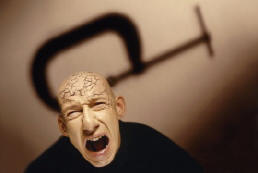 April
20th, 2004.
Pain is unavoidable. We
all know that, or at least we should. But, man -- how
we try to deny its inevitability! Think about how much
of our lives are spent trying to run from the truth of pain.
April
20th, 2004.
Pain is unavoidable. We
all know that, or at least we should. But, man -- how
we try to deny its inevitability! Think about how much
of our lives are spent trying to run from the truth of pain. April
21st, 2004.
Often in
relationships we find that no matter how hard we try, we
cannot let go of our distrust. We find that open,
trusting relationships are simply impossible. Perhaps
this is because of incidents that occurred in our past.
If we were taught that the world is a frightening and
dangerous place, it's no wonder that we can't trust anyone.
April
21st, 2004.
Often in
relationships we find that no matter how hard we try, we
cannot let go of our distrust. We find that open,
trusting relationships are simply impossible. Perhaps
this is because of incidents that occurred in our past.
If we were taught that the world is a frightening and
dangerous place, it's no wonder that we can't trust anyone.
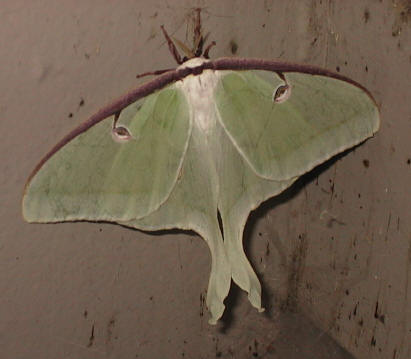 April
25th, 2004.
Check out the picture I took
of the Luna moth at the left. I saw this fellow a few
years ago on the porch of a place I used to live.
These moths are rare in east Tennessee, by the way.
April
25th, 2004.
Check out the picture I took
of the Luna moth at the left. I saw this fellow a few
years ago on the porch of a place I used to live.
These moths are rare in east Tennessee, by the way.
 May
16th, 2004.
There's an interesting
concept in Buddhism called anatta, or "no-self."
Simply put, when Prince Gautama was meditating on the nature
of what it is to be a human being, he discovered that he
could break the human being into five skhandas or
"aggregates." After a person is broken down into these
aggregates, he discovered there was no "I" or self.
May
16th, 2004.
There's an interesting
concept in Buddhism called anatta, or "no-self."
Simply put, when Prince Gautama was meditating on the nature
of what it is to be a human being, he discovered that he
could break the human being into five skhandas or
"aggregates." After a person is broken down into these
aggregates, he discovered there was no "I" or self.
 May
17th, 2004.
Here's one for you:
May
17th, 2004.
Here's one for you:
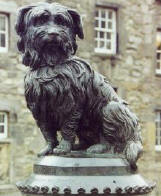 (1) You will not
find very many monuments to dogs in this world. But in
Edinburgh, Scotland, in a public area known as Greyfriar
Square, there stands a statue, erected by the local
citizens, in honor of a little terrier named Bobby.
(1) You will not
find very many monuments to dogs in this world. But in
Edinburgh, Scotland, in a public area known as Greyfriar
Square, there stands a statue, erected by the local
citizens, in honor of a little terrier named Bobby.
 May
23rd, 2004.
Still 246 pounds (hard for me
to believe, when you consider that at this time last year I
was nearly 296 pounds) still vegetarian (still hard to
believe how easy it is to avoid meat -- no cravings at all)
and still have a fairly good outlook on life, although I
have my moody moments.
May
23rd, 2004.
Still 246 pounds (hard for me
to believe, when you consider that at this time last year I
was nearly 296 pounds) still vegetarian (still hard to
believe how easy it is to avoid meat -- no cravings at all)
and still have a fairly good outlook on life, although I
have my moody moments.
 Well,
that's not entirely true. Vegetarianism is a
different story. I don't eat meat for ethical reasons.
There are a whole lot of health reasons that make a
vegetarian lifestyle very attractive as well, but for me the
primary reasons for abandoning meat are ethical. So,
it's not like I can have a hamburger or a rack of ribs and
blow it off like I did the chocolate/caramel masterpiece.
I can't simply say that it was just a few extra calories
that will even out in the long run. It would be a
violation of my personal ethics, and that's something I take
very seriously.
Well,
that's not entirely true. Vegetarianism is a
different story. I don't eat meat for ethical reasons.
There are a whole lot of health reasons that make a
vegetarian lifestyle very attractive as well, but for me the
primary reasons for abandoning meat are ethical. So,
it's not like I can have a hamburger or a rack of ribs and
blow it off like I did the chocolate/caramel masterpiece.
I can't simply say that it was just a few extra calories
that will even out in the long run. It would be a
violation of my personal ethics, and that's something I take
very seriously.